

Preschool Handwriting Practice: Why Reusable Cards Beat Printable Worksheets
What the research actually shows about preschool handwriting prep: the four-stage grip progression, why disposable worksheets fall short, and the reusable approach that supports hundreds of repetitions.
“Printable worksheets are consumable. Preschool handwriting is not. Children need hundreds of repetitions — and disposable paper isn’t the answer.”

Hundreds of repetitions, one set of cards — not a recycling bin of paper.

4 stages
Of pencil grasp development between ages 2 and 6
Schneck & Henderson, 1990

73%
Of kindergarten readiness is predicted by preschool fine motor scores
Fine motor readiness research

2nd grade
Achievement is predicted by PreK fine motor more than demographics
Dinehart & Manfra, 2013
The 4 Stages of Pencil Grip Development

Age 2-3
Palmar grasp
The fist wraps around the tool, motion comes from the shoulder. Tools should be chunky and surfaces large — precision isn’t the goal here.

Age 3-4
Digital pronate
Fingers grip from above, wrist turns down. Lines become more deliberate but the elbow is still doing the work.

Age 4-5
Static tripod
Three fingers hold the pencil but move together as one unit. This is when most preschool letter formation starts to feel possible.

Age 5-6
Dynamic tripod
Fingers move independently of the hand. Letter formation becomes fluent and the foundation for first-grade writing is in place.
The 3-Step Framework Preschool Teachers Use

Wide trace lines
Begin with chunky markers on wide lines. The goal is confidence with the motion, not accuracy with the shape. Big strokes on big surfaces match where the hand actually is in preschool.

Refine the grip
Once wide strokes feel automatic, swap chunky tools for skinnier ones. A skinnier shaft naturally invites a tripod grip — the tool teaches the hand without correction.

Add letter shapes
Once grip refines, introduce letter formation — capitals first, then lowercase. The child meets letters with a hand that already knows the strokes, which makes the difference between fluent and forced.
Built For This
The Reusable Alternative to Printable Worksheets
The problem with preschool handwriting practice isn’t the practice — it’s the format. A preschooler needs hundreds of repetitions to build the strokes that become letters, and printable worksheets are designed to be used once and recycled.
The Trace Lab is a set of dry-erase trace cards paired with a 49-page progression guide. The cards begin with wide strokes and move through capital and lowercase letters. The guide tells parents which card to use at which grip stage.
Every variant ships with: foundation stroke cards, 26 dry-erase letter cards, a chunky dry-erase marker, a wipeable storage pouch, and the free Trace Lab Guide ($49 value) with developmental plans for each grip stage.

The Trace Lab
Reusable handwriting practice system — strokes to words
30-day satisfaction
Three Myths Preschool Parents Hear
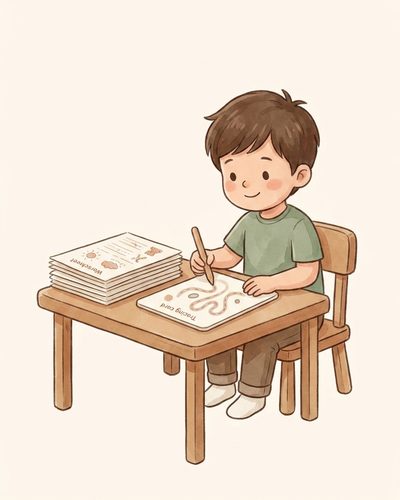
“Print 50 worksheets and they’ll learn.”
Reality
Repetition is exactly right. The format is the problem. A child needs hundreds of repetitions; a stack of fifty paper sheets covers a fraction of that and ends in the recycling bin. Reusable cards do the same work for years.
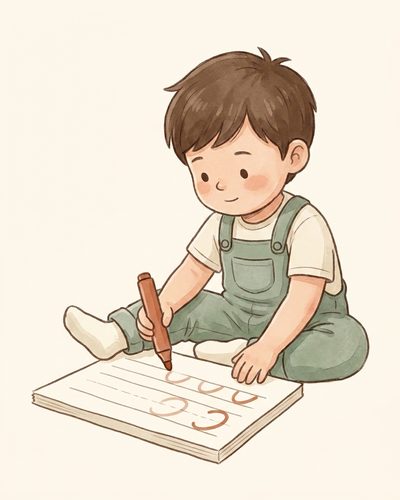
“Preschool handwriting prep is unnecessary.”
Reality
Fine motor skills at the preschool stage are one of the strongest predictors of kindergarten writing success. Prep doesn’t mean drilling letters — it means building the strokes and grip that letters rest on.
Dinehart & Manfra, 2013
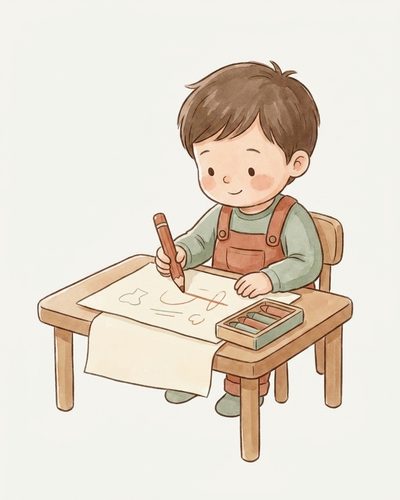
“Use whatever pencil they grab.”
Reality
Tool sizing matters. Chunky pencils suit early palmar and pronate grips. Standard pencils suit refined tripod grips. Matching the tool to the stage prevents the hand from compensating with tension.
Schneck & Henderson, 1990
Ready to put this into practice?
Four grip stages, one reusable system — and a 49-page guide that maps daily practice from wide strokes through refined letter formation.


Common Questions
Most preschoolers are ready for stroke and grip work between ages 3 and 4. Letter formation usually fits between 4 and 5. Start with strokes regardless of age — letters can wait.
Pre-writing is the strokes that letters are built from. Preschool handwriting is what happens once those strokes feel reliable enough to combine into letters. One leads to the other.
Capitals first. They’re built from straight lines and a few curves — easier to plan and execute than the tighter circles of lowercase. Lowercase emerges naturally once capitals feel automatic.
The right question is how many repetitions, not how many worksheets. Most preschoolers need hundreds of repetitions across all letter shapes. A small set of reusable cards covers this; a stack of printed sheets typically doesn’t.
Step back to whichever stage felt successful and shorten sessions. Most resistance comes from a mismatch between task difficulty and current grip stage. Five fun minutes beats fifteen frustrated minutes.
For preschool, yes. The math is straightforward: one printable supports one practice session; one reusable card supports hundreds. Cost per use, waste, and continuity all favor reusable.
Match thickness to grip stage. Palmar and pronate grips need chunky pencils or markers. Static and dynamic tripod grips work better with standard-thickness pencils. Switch when the grip refines, not before.
By kindergarten, children who’ve practiced strokes and refined grip can focus on the new task — letters and words — rather than fighting their hands. The preschool work is the runway, not the flight.