

Pre-Writing Skills: A Developmental Guide for Ages 3 to 6
What the research actually shows about the four-stage pencil grip progression, when strokes should come before letters, and why pre-writing — not handwriting — is the real foundation of legible writing.
“Pre-writing isn’t about teaching letters. It’s about building the fine motor sequence — palmar grasp to tripod grip — that makes letter formation possible by age 6.”

Palmar to tripod — a 3-year hand journey.

4 stages
Of pencil grasp development between ages 2 and 6
Schneck & Henderson, 1990

73%
Of kindergarten readiness is predicted by preschool fine motor scores
Fine motor readiness research

2nd grade
Academic achievement predicted by PreK fine motor more than demographics
Dinehart & Manfra, 2013
The 4 Stages of Pencil Grip Development

Age 2-3
Palmar grasp
The whole hand wraps the tool. Marks are large, motion comes from the shoulder, and precision is years away. This is normal and expected.

Age 3-4
Digital pronate
Fingers grip from above with the wrist turned down. Motion still comes from the elbow, but lines start to feel more deliberate.

Age 4-5
Static tripod
Three fingers hold the pencil, but they move as one unit. Most kindergarten letter shapes are formed at this stage.

Age 5-6
Dynamic tripod
The fingers move independently of the hand. This is when handwriting becomes fluent and the foundation is officially in place.
The 3-Step Framework Therapists Use

Strengthen the hand
Before any pencil work, the small muscles of the hand need volume. Playdough, tongs, clothespins, pop-beads, and finger games build the strength a child draws on later. Ten minutes a day of squeeze-and-pinch is enough.

Introduce strokes
Vertical lines, horizontal lines, circles, and crosses are the motor library every letter is built from. Practice these in isolation, on large surfaces, with chunky tools. Letters can wait until the strokes feel automatic.

Stack to letters
Once strokes are reliable, combine them into letter shapes. A “t” is a vertical line plus a horizontal line. An “o” is a single circle. Children who arrive here on strong strokes form letters with ease rather than frustration.
Built For This
The Tool That Bridges Strokes to Letters
The challenge with pre-writing isn’t the science — it’s having a single set of materials that follow a child from chunky strokes through letter formation. Most early-writing toys cover one stage and stop.
The Trace Lab is a set of dry-erase trace cards paired with a 49-page progression guide. The cards begin with foundation strokes and move through capital letters, lowercase letters, and short words. The guide gives parents week-by-week sessions tied to the four grip stages.
Every variant ships with: foundation stroke cards, 26 dry-erase letter cards, a chunky dry-erase marker, a wipeable storage pouch, and the free Trace Lab Guide ($49 value) with developmental plans for each grip stage.

The Trace Lab
Reusable pre-writing and handwriting system — strokes to words
30-day satisfaction
Three Myths About Pre-Writing
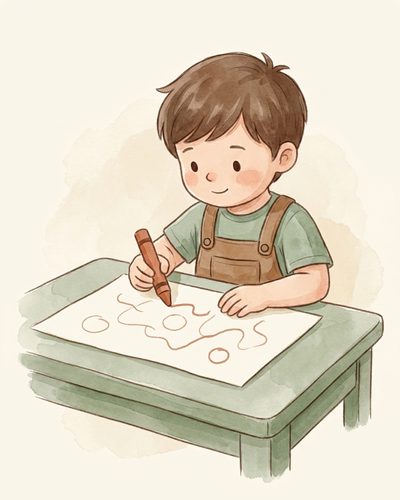
“Tracing letters teaches writing.”
Reality
Pre-writing strokes have to come first. Letters combine multiple strokes at once — too complex for a hand that hasn’t yet rehearsed the parts. Trace letters once strokes feel automatic, not before.
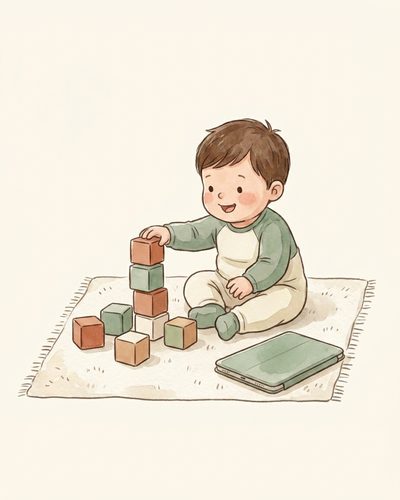
“Pre-writing apps are educational.”
Reality
Hand-drawn letters activate reading-related neural circuits that touchscreen tracing does not. Physical pencils, crayons, and chalk beat apps for ages 2-5 by a wide margin.
James & Engelhardt, 2012
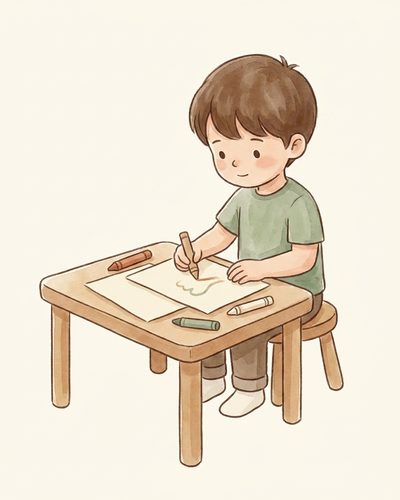
“My child should write their name by 4.”
Reality
Name writing emerges naturally between ages 4 and 6, when the grip refines from static to dynamic tripod. Pushing it before the hand is ready usually creates frustration, not letters.
Schneck & Henderson, 1990
Ready to put this into practice?
Four grip stages, one reusable system — and a 49-page guide that tells parents what to do at each developmental window.


Common Questions
As soon as your child shows interest in marking surfaces — usually between 18 months and 2 years. Start with chunky tools and big surfaces. Formal stroke practice fits best between ages 3 and 4.
Not at all. Name writing emerges naturally between ages 4 and 6, when the grip refines toward dynamic tripod. If your 4-year-old can’t yet, focus on grip-building and stroke practice rather than letters.
Short. For ages 2-3, five minutes is plenty. For ages 4-5, ten to fifteen minutes works. Stop before frustration starts — a positive ending matters more than total time.
Technically yes, but it usually backfires. Letters are bundles of pre-writing strokes. A child who hasn’t practiced the strokes treats each letter as a fresh puzzle, which is exhausting and often produces avoidance.
Fist grip (palmar grasp) is the first developmental stage and completely normal up to age 3. Don’t correct it directly — build hand strength with playdough and tongs, and the grip will refine on its own as the muscles mature.
Most children don’t. An OT consult makes sense if grip is still palmar at age 5+, if your child avoids all fine motor activity, or if a pediatrician flags a concern. Otherwise daily play with developmentally matched tools is enough.
Sparingly. Model the correct grip silently by sitting beside your child and using your own pencil. Direct correction tends to make children grip tighter, not better.
Pre-writing is the strokes — lines, circles, crosses — that letters are built from. Handwriting is what happens when those strokes get assembled into letters and words. One leads to the other; you can’t skip ahead.