

Number Recognition Activities for Preschoolers: A Developmental Map (Ages 2-5)
What the research actually shows about when children recognize numbers, how cardinality develops, and the three-stage activity framework most parents skip.
“Number recognition isn’t about memorizing symbols. It’s about three sequential cognitive shifts — subitizing, one-to-one correspondence, and cardinality — that unfold between 18 months and age 5.”

Counting becomes recognition becomes quantity — a 3-year journey.

1,000,000+
New neural connections per second in the first 3 years of life
Harvard Center on the Developing Child

5 stages
Of cognitive number development between 18 months and age 5
Gelman & Gallistel, 1978

18 months
When most children begin subitizing — instantly recognizing quantities of 1, 2, or 3 without counting
Clements & Sarama, 2014
The 5 Stages of Number Development

18 months
Subitize 1-3
Most toddlers can instantly recognize one, two, or three objects without counting. This is the foundation of all later number sense.

2 years
Rote count
Children begin reciting the count sequence (“one, two, three, four”). Often without yet understanding what numbers mean — that’s normal and developmentally appropriate.

3 years
One-to-one correspondence
Children touch each object once as they count. This is the bridge from rote counting to actual quantity awareness.

4 years
Cardinality
Children grasp that the last number counted represents the total quantity. “There are FOUR cars” — they understand this.

5 years
Symbol-quantity link
Children connect the written numeral “5” to the quantity of five things. This is when number recognition (the activity this page is about) fully clicks.
The 3-Step Framework Researchers Use

Match
Start with matching numerals to outlines or shape pieces. The child sees the symbol “3” and places a piece labeled “3” onto a matching outline. This builds visual recognition of the numeral shape — without yet requiring counting.

Name
Once they can match, attach the spoken word. Point and say: “This is three.” Don’t quiz. Don’t rush. Repetition over weeks builds the verbal-visual link.

Quantify
Bridge symbol to quantity. Place 3 small objects beside the numeral 3. “We have THREE blocks. One, two, three. This is the symbol for three.” This is cardinality — and it usually clicks somewhere between ages 3 and 4.
Built For This
The Tool That Maps the 5 Stages
The challenge with number recognition isn’t conceptual — it’s having physical materials that progress through all five stages. Most kids’ counting toys cover one stage and stop.
The Number Lab is a wooden puzzle paired with a 50-page progression guide. The 12 colored geometric number shapes work for matching (Stage 1). The clock-puzzle structure adds quantity context (Stage 2-3). The included guide gives parents week-by-week session scripts.
Every variant ships with: 12 numbered geometric shapes (1-12), wooden puzzle base, eraseable activity cards, and the free Number Lab Guide ($49 value) with 8-week progressive plan.

The Number Lab
Multi-skill shape, number, and quantity recognition system
30-day satisfaction
Three Myths Parents Hear Daily

“My child should be writing numbers by 4.”
Reality
Number recognition comes first; writing numerals is a motor skill that follows by age 5-6. Pushing the writing too early can frustrate without benefit.
Cameron et al., 2012
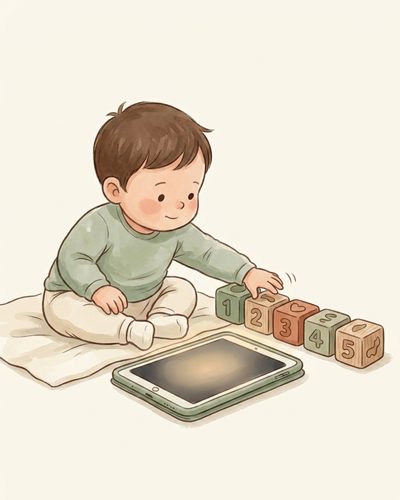
“Counting apps are educational.”
Reality
Touchscreen tapping bypasses the fine motor and tactile sensory channels through which the developing brain best encodes quantity. Physical objects beat apps for ages 2-5.
Hutton et al., 2020, JAMA Pediatrics
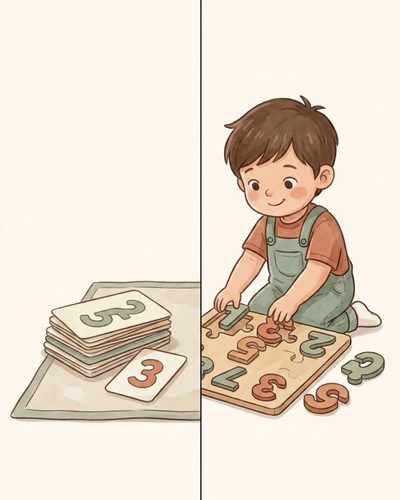
“Flashcards build number recognition fastest.”
Reality
Guided play has measurably stronger effects than direct instruction on early math outcomes (effect size g = 0.93). Embedded play beats drill.
Weisberg meta-analysis, 2016
Ready to put this into practice?
Five stages of number development, one structured tool — and a 50-page guide that tells you what to do each week.


Common Questions
Most children show readiness for subitizing (recognizing small quantities) between 18-24 months. Formal number recognition activities work best between ages 2.5 and 5. There’s no harm in introducing earlier — children explore quantity through play even before they can name numbers.
Yes — this is the gap between rote counting and cardinality. Reciting numbers in order (“one, two, three...”) is a memorized sequence; understanding that “three” represents a group of three things is a separate cognitive skill. Cardinality typically clicks between ages 3-4. Keep doing one-to-one correspondence activities (touch and count) to bridge the gap.
For ages 2-3, sessions of 5-10 minutes are ideal. For ages 4-5, 15-20 minutes works. Quality matters more than duration. Five focused minutes beats thirty minutes of forced practice.
Research consistently shows guided play (embedding number practice in play activities) outperforms direct instruction like flashcards for preschool-age children. Save flashcards for older kids or use sparingly.
Reversals are completely normal until around age 6-7. They reflect spatial reasoning still under construction, not a learning issue. Gently model the correct direction during writing time, but don’t repeatedly correct or it can create anxiety around math.
Physical manipulatives — puzzles, blocks, sorting toys — generally outperform paper worksheets for ages 2-5. Touch and movement activate more brain regions during learning. Worksheets become more useful around age 5-6 when fine motor and pencil grip mature.
Wide individual variation is normal. Some 3-year-olds recognize numbers 1-10; others won’t until 5. If your child shows no interest by age 4-5 or is significantly behind peers, a brief screening with a pediatrician or early childhood specialist can rule out specific learning differences. Most “behind” kids simply need more time and play exposure.
Yes — and there’s evidence mixed-age play helps both children. Older siblings cement their knowledge by teaching; younger siblings absorb naturally through observation. Just ensure activities are mostly appropriate for the younger child.