

How to Teach Numbers to Preschoolers: A Research-Backed Approach
What the research actually shows about how preschoolers learn numbers — why flashcards underperform, what guided play does instead, and the three cognitive stages every child moves through.
“The fastest way to teach a preschooler numbers is to stop trying. Embed numbers in play. Children learn most when they don’t know they’re being taught.”

Play teaches numbers six times more than drill.

g = 0.93
Effect size of guided play vs direct instruction on early math outcomes
Weisberg meta-analysis

15 min
Daily practice consistently beats long weekly sessions for preschool learning
Early learning research

3 stages
Of cognitive number development: subitize, count, cardinality
Gelman & Gallistel, 1978
The 5 Stages Children Move Through

~ 2 yrs
Spot
Children begin instantly recognizing groups of 1, 2, or 3 without counting — this is called subitizing, and it’s the foundation.

~ 2-3 yrs
Name
The count sequence appears: one, two, three. The words come before the meaning — and that’s normal.

~ 3 yrs
Count
One-to-one correspondence: each object gets one number, said once. This is the bridge from words to quantity.

~ 4 yrs
Match
Cardinality clicks. The last word spoken — “three” — represents the whole group. This is the cognitive leap.

~ 5 yrs
Symbolize
The numeral “5” connects to the quantity. This is when number recognition becomes truly meaningful.
The 3-Step Framework for Parents

Subitize naturally
Point out small groups in daily life. “Look, two birds.” “You have three blueberries.” No quizzing — just naming. Repetition over weeks builds the foundation that counting later sits on.

Add 1-to-1 touch counting
Once your child seems interested in counting, model the touch. Point as you say each number; have them point with you. Counting that physically maps a word to an object is what produces real understanding.

Introduce cardinality
After touch counting, pair the final number with the total. “One, two, three. Three apples.” The last word is the answer to “how many?” This is the conceptual leap that unlocks all later math.
Built For This
The Hands-On System That Maps Each Stage
Teaching numbers to preschoolers isn’t about a clever app or a stack of flashcards. It’s about having physical materials that move through the actual cognitive stages — subitizing, counting, and cardinality — in order.
The Number Lab is a wooden puzzle paired with a 50-page progression guide. The 12 colored geometric number shapes support all five timeline stages, from spotting small groups to linking numerals with quantities. The guide gives parents week-by-week scripts for natural conversation.
Every variant ships with: 12 numbered geometric shapes (1-12), wooden puzzle base, erasable activity cards, and the free Number Lab Guide ($49 value) with an 8-week progressive plan.

The Number Lab
Multi-skill shape, number, and quantity recognition system
30-day satisfaction
Three Myths Parents Hear About Teaching Numbers
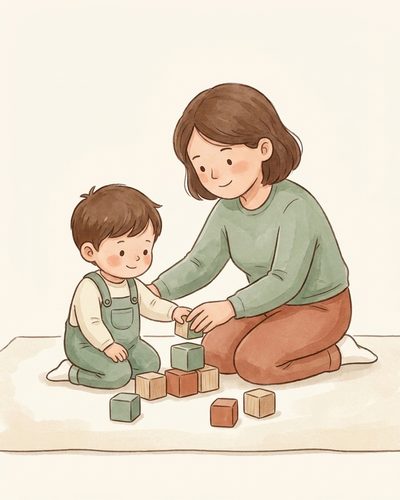
“Flashcards teach numbers fastest.”
Reality
Guided play has a much stronger effect on early math outcomes than direct instruction like flashcards (g = 0.93). Save flashcards for older children — or skip them entirely at this age.
Weisberg meta-analysis
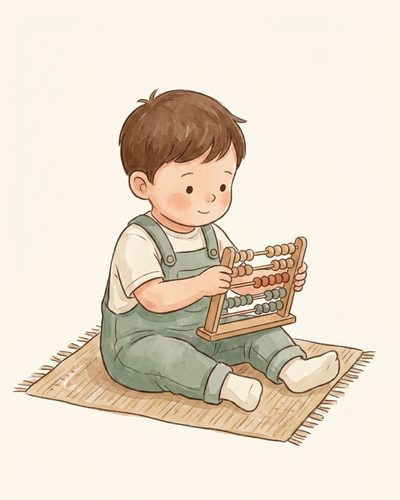
“Earlier is better.”
Reality
Pushing formal number teaching before age 2.5 doesn’t accelerate development — it often creates resistance. Subitizing emerges around 18 months on its own; let it.
Clements & Sarama, 2014
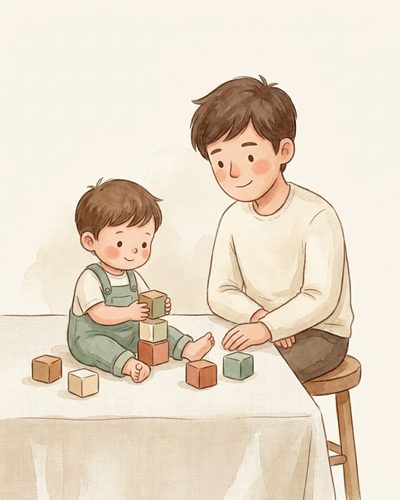
“TV counting shows are educational.”
Reality
Passive viewing produces no measurable gain in number recognition for preschoolers. Number understanding requires active manipulation — hands on objects, words paired with touch.
Hutton et al., 2020, JAMA Pediatrics
Ready to put this into practice?
Five cognitive stages, one structured tool — and a 50-page guide that turns the science into 15 minutes of daily play.


Common Questions
Subitizing begins around 18 months on its own. Formal embedded play with numbers fits well between ages 2.5 and 5. There’s no benefit to starting earlier — and some risk of creating resistance.
Not for this age. The research consistently shows guided play outperforms direct instruction for preschool math. Flashcards have a place in older grades; not in the preschool years.
Stop asking. Counting that feels like a quiz produces refusal. Instead, count out loud yourself in everyday moments — stairs, snacks, toys. Children almost always join in within a few weeks.
Ten to fifteen minutes a day is the sweet spot. Embedded in play, not at a table. Daily short sessions beat long weekly ones at almost every age.
Yes. Counting comes first (the word sequence), then one-to-one correspondence, then cardinality, and only then numeral recognition. Trying to recognize the symbol “5” before counting feels random; after counting, it makes sense.
Counting is the recitation: one, two, three. Cardinality is the understanding that the last word represents the total. Many preschoolers count fluently long before they grasp what counting means.
Touchscreen tapping bypasses the tactile and motor channels that preschoolers learn through best. Physical objects beat apps for ages 2-5 by a wide margin. Save apps for older children.
Most children recognize 1-10 by age 5, with wide individual variation. Some 3-year-olds know them; some 5-year-olds don’t. The path matters more than the timeline.