

DIY Busy Board for Toddlers: Why Most Don’t Work (And the Smart Alternative)
An honest look at why most DIY busy boards fail within weeks, what a developmentally effective board actually includes, and when it’s worth skipping the DIY entirely.
“DIY busy boards fail for the same reason DIY shoes fail: hand-crafting doesn’t guarantee fit. Toddlers need specific switch types in specific sequences — and Pinterest doesn’t know your child.”

Effort doesn’t equal effectiveness — design does.

~ 2 weeks
Common engagement window for most DIY toddler toys before interest fades
Parenting community observations

8 switches
Distinct motor patterns a well-designed busy board can exercise
Busy board design principles

LED loop
Closed-loop feedback is hard to build into passive DIY materials
Closed-loop learning principles
5 Things a Successful Busy Board Has

Element 1
Safe materials and edges
Smooth wood, no small parts, no exposed hardware. Anything that could pinch, splinter, or detach is a non-starter.

Element 2
Variety of switch types
Toggles, knobs, dials, keys, and joysticks each exercise a different fine motor pattern. One mechanism repeated bores quickly.

Element 3
Real feedback
An LED that lights, a click that clicks — cause-and-effect a toddler can see. Passive switches without feedback lose interest fast.

Element 4
Age-appropriate complexity
Switches that match the child’s current fine motor stage. Too easy, and the child outgrows it in a week. Too hard, and they avoid it.

Element 5
Durability
Built to survive years of toddler force. Glue-and-hardware DIYs typically don’t. The board has to outlast the phase.
The 3-Step Framework: DIY vs Designed

What DIY tries to achieve
A busy board, well done, gives toddlers hands-on switches to exercise developing fine motor and attention skills. The intent is real, and the science behind tactile play is solid.

Where DIY falls short
Safety standards, durability, switch variety, and built-in feedback are hard to deliver in a single weekend project. Most DIY boards lose engagement within weeks and end up in the closet.

The structured alternative
Tested switches, LED feedback, age-graded complexity, and a 4-week parent protocol — engineered for years of use. The result: a board that earns its place on the shelf rather than the donate pile.
Built For This
The Engineered Busy Board That Earns Its Spot
The problem with DIY busy boards isn’t the idea — it’s the execution. Safety standards, switch variety, real feedback, and durability are hard to combine in a single Saturday afternoon. Most DIYs end up in the closet within a month.
The Focus Builder is a wooden busy board engineered with eight tested switch types, LED feedback, and age-graded difficulty. It ships with a 50-page parent guide that lays out a 4-week protocol for executive function and attention play.
Every variant ships with: a sanded hardwood frame, 8 fine motor switches, LED feedback elements, magnetic closures, and the free Focus Builder Guide ($49 value) with the 4-week play plan.

The Focus Builder
Engineered busy board with feedback and protocol
30-day satisfaction
Three Myths About DIY Busy Boards
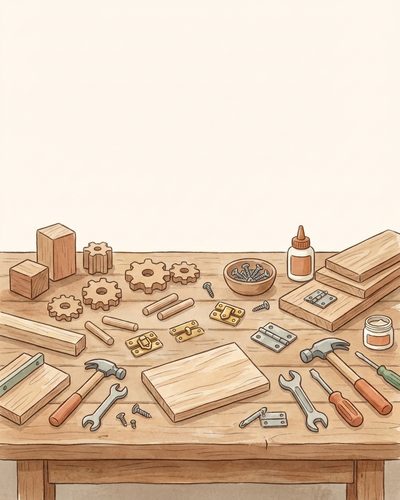
“DIY is cheaper.”
Reality
Once you tally hardware, wood, finish, and the eight or more hours of build time, materials often exceed $40. And most DIY boards stop working within thirty days — so the per-month cost climbs fast.
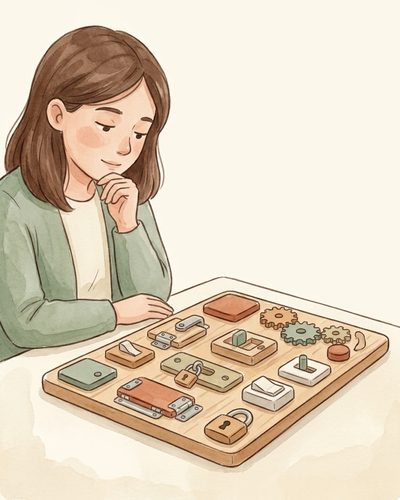
“Pinterest tutorials work.”
Reality
A tutorial shows one parent’s build for one child. It rarely accounts for child-safety standards or developmental progression. What looks good in the photo doesn’t always survive contact with a real toddler.
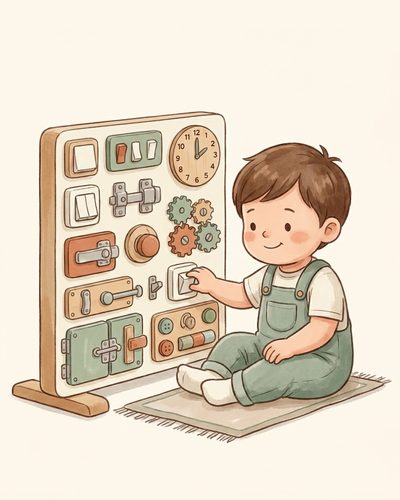
“Toddlers like anything tactile.”
Reality
Engagement comes from switches that do something. A latch with no payoff bores within a few sessions. A switch that produces a click, a light, or a satisfying mechanical event keeps holding attention.
Ready to skip the DIY?
Eight switches, real LED feedback, and a 50-page guide that turns play into structured executive-function practice.


Common Questions
Sometimes. If you enjoy the build itself and have woodworking skills, a thoughtful DIY can land well. For most parents, the time-to-result and the durability gap make a designed board the better trade.
A sanded wooden base, child-safe finish, an assortment of switches, magnetic closures, and ideally some battery-powered LEDs. Skip anything with sharp edges, small detachable parts, or strong glue near the play surface.
Only if the parent applies the same standards a manufacturer would: rounded edges, no small parts, secure fastenings, child-safe finish. Pinterest tutorials often skip these steps.
Realistically, $40-80 in parts plus eight or more hours of labor. The hidden cost is durability: many DIYs need rebuilds within a few months, which doubles the bill.
Most lose engagement within a couple of weeks and break or loosen within a few months under daily toddler force. Well-engineered boards designed for the same job typically outlast that by years.
Roughly 12 months to 4 years, depending on switch complexity. Younger toddlers need bigger, simpler switches; older ones can handle multi-step mechanisms. Age-graded design is what extends the useful life.
Five things: safe materials and edges, a variety of switch types, real cause-and-effect feedback, age-matched complexity, and durability that survives years of toddler force. Miss any of these and engagement drops fast.
Engineering and a protocol. Eight tested switches, LED feedback, child-safe finish, and a 4-week parent guide that maps which switch to introduce when. DIY can deliver one of those; bringing them together is the work.